13-week cash flow template
Thirteen weeks is far enough ahead to fix a problem and close enough to be accurate. This is the workbook we use as a starting point with clients, with the formulas built in and two worked examples, so you can see what a bad week looks like before it happens.
What is in the workbook
Instructions.
Six steps for filling it in and keeping it current, plus what each sheet is for.
Forecast.
The blank template. Opening cash, four receipt lines, ten disbursement lines, then total receipts, total disbursements, net cash flow, ending cash, your cash floor, the cushion above it, and a flag for any week below the floor. White cells are inputs. Shaded cells are formulas.
Example, base case.
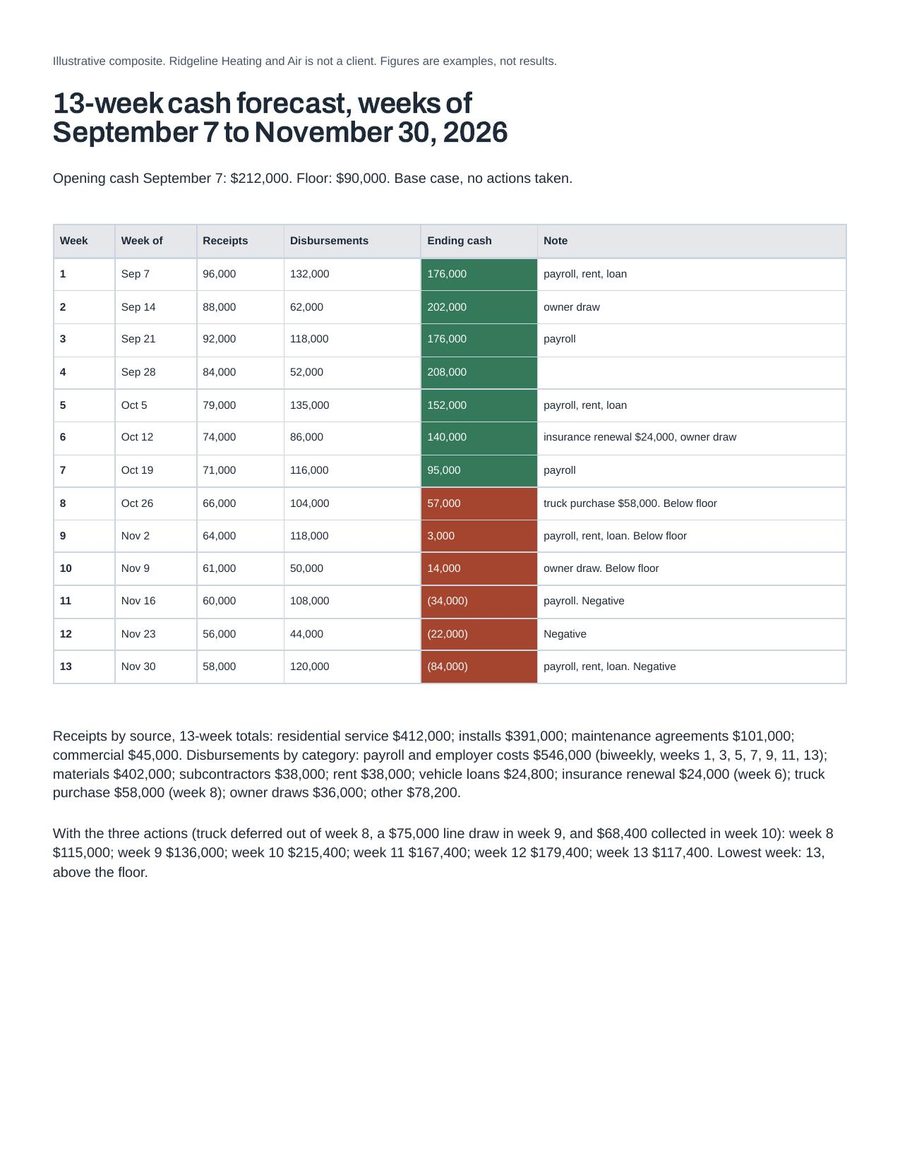
A composite HVAC contractor heading into the slow season with a truck purchase planned. Cash drops below the floor in week 8 and goes negative in week 11.
Example, with actions.
The same company after deferring the truck, drawing on the line of credit in week 9, and collecting three overdue invoices in week 10. The lowest week stays above the floor.
How to use it
- Enter your company name, the Monday that starts week 1, and your cash floor. The floor is the minimum balance you want to keep, often one payroll plus rent.
- Enter opening cash for week 1: the bank balance on that Monday, less checks written but not yet cleared.
- Fill receipts by week. Use what customers will actually pay, not what you will invoice. Start from the aging report and your payment terms.
- Fill disbursements by week. Put payroll, rent, loan payments, insurance, and owner draws in the weeks they leave the bank. Then materials, subcontractors, and everything else.
- Read the Ending cash row. A week at or above the floor shows green. A week below the floor shows red. That is the week you plan for, starting now.
- Update every week. Replace last week's forecast with actuals, add week 14 at the end, and note what you got wrong. The forecast gets better fast.
What to do with a red week
A red week is not a crisis if you see it in September and it lands in November. The moves are usually the same: collect what is owed, delay what can wait, draw on the line before you need it, and pause the spend that is not paying back. The forecast tells you which week, how much, and for how long.
The example sheets use an illustrative composite. Ridgeline Heating and Air is not a client. Figures are examples, not results.
Cash is the question we get asked first.
The forecast goes live in your second month on the Clarity plan, built from your bank activity and updated every week.